
Every so often a book comes along that doesn't just explain something, it reorganizes the furniture in your head so you can never walk through the room the same way again. That's what Jesus and John Wayne did to me. It's ostensibly a history of white evangelicalism's eighty year courtship with a particular brand of militant, hyper-masculine Americanism. In practice it's the most coherent explanation I've encountered for why so many people who taught me about grace ended up cheering for a man who has never, as far as anyone can tell, exhibited any.
Kristin Kobes Du Mez is a historian, and she writes like one: patient, exhaustively sourced, uninterested in cheap shots because the material doesn't need them. The book builds the way a good documentary builds, not through a single smoking gun but through decades of small, compounding choices. A radio broadcast here. A men's ministry conference there. A bestselling marriage book that quietly recasts submission as strength. By the time you arrive at 2016, the ending doesn't feel like a plot twist. It feels like the only place the story could have gone. That's the trick of good history writing: it makes the surprising feel inevitable in retrospect, which is a much harder thing to pull off than it sounds.
What Du Mez nails, and what I haven't seen articulated this clearly anywhere else, is how theology, politics, and pure culture-industry marketing became functionally indistinguishable inside this world. There's a passage that's been rattling around in my skull for weeks now:
"In the end, Doug Wilson, John Piper, Mark Driscoll, James Dobson, Doug Phillips, and John Eldredge all preached a mutually reinforcing vision of Christian masculinity: of patriarchy and submission, sex and power. It was a vision that promised protection for women but left women without defense, one that worshiped power and turned a blind eye to justice, and one that transformed the Jesus of the Gospels into an image of their own making."
I underlined that one hard enough to tear the page, mostly because I recognized myself in it. In college I was fully inside that vision. I read the books, absorbed the framework, built a chunk of my early theology on Piper's certainty and Driscoll's swagger. It's uncomfortable to look back on now, in the way it's uncomfortable to look at old pictures of yourself in a shirt you thought was cool. Those men taught me real things about the gospel, and I'm not going to pretend otherwise just because it's tidier. But the blind spots were massive, and they weren't incidental to the teaching, they were structural to it. Du Mez's real achievement is showing that this wasn't a bug in evangelical culture. It was the architecture. I got out, mostly by luck and grace and a few people who nudged me sideways at the right moments, and reading this book felt less like learning new information and more like finally being handed a map of a maze I'd already walked through blind.
If you want to understand why American evangelicalism looks the way it does right now, why "strength" got confused with "godliness" and why a lot of people you know got very comfortable with cruelty as long as it came wrapped in a flag, this is the book. Essential reading, genuinely, for Christians especially. Not because it will make you feel good. It won't. But it will make you understand something you've probably been feeling for a decade without having the words for it.
All reviews
Book review
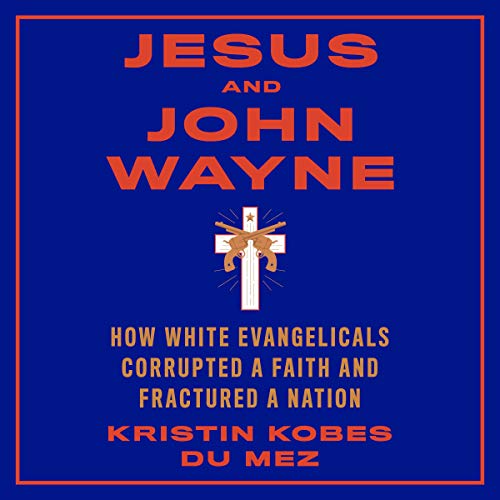
Jesus and John Wayne: How White Evangelicals Corrupted a Faith and Fractured a Nation
Told A Stranger About It Unprompted