

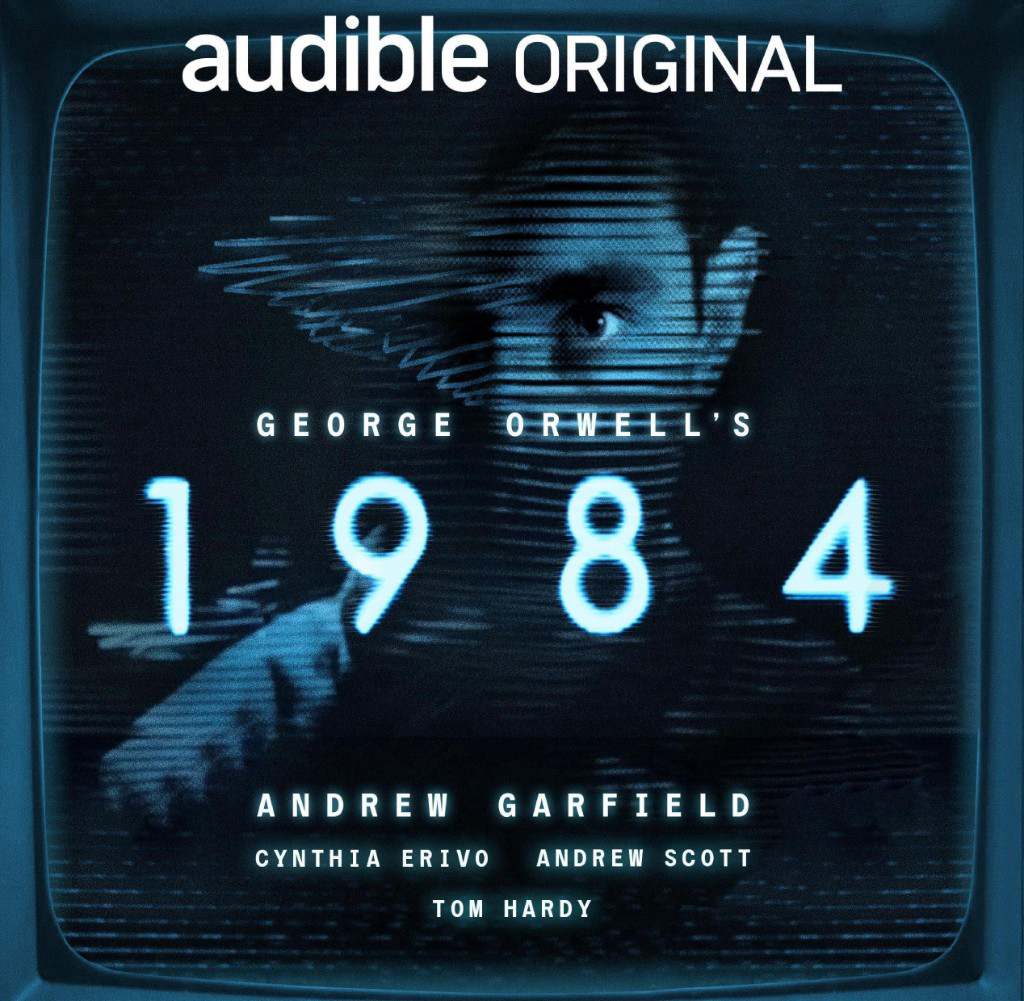
Andrew Garfield's Winston Smith is the reason I'm no longer willing to write off audiobooks as a lesser way to experience a story.
I'm not much of an audiobook guy. Outside of Dungeon Crawler Carl and Jeff Hays doing career-best work as its narrator, I stick to the page. But this production kept turning up everywhere, and I'll follow Andrew Garfield into just about anything at this point, so I gave it a shot. At four to five hours, the runtime made the decision easy — even a swing and a miss wasn't going to cost me much. It wasn't a miss. It was fantastic.
It's a full-cast production, with Cynthia Erivo, Andrew Scott, and Tom Hardy voicing Big Brother himself, and that scale is what turns Winston's interrogation and unraveling into something closer to a radio drama than an audiobook. The score, from Matt Bellamy of Muse and composer Ilan Eshkeri, played by a 60-piece orchestra, does real narrative work instead of just sitting under the dialogue as texture. The performances land harder because of it. Garfield in particular finds a kind of quiet, fraying desperation in Winston that made me want a proper screen adaptation with him in the role. The audio version proved he could carry it.
My one real complaint: the mix. There were stretches where the sound design and score got loud enough to step on the dialogue, and I found myself rewinding a few seconds just to catch a line I'd lost under the noise. Minor, but noticeable enough to mention.
Whether an audiobook "counts" as reading is a debate I'll leave for someone else. What I will say is that Orwell's ideas hit differently when you sit with them as adults rather than as required reading in high school. Stripped of the classroom context, it's funny, and a little unsettling, how much of 1984's ideological anxiety both the left and right now claim as their own warning, aimed at each other. Orwell wasn't writing a partisan pamphlet. He was describing a mechanism, and the fact that mechanism still fits so many current arguments, from either direction, says more about where we are than either side would probably like to admit.
This might be the best format 1984 has ever been told in, and I say that as someone who thought he was done with it after high school.